What if it's not arthritis?
The ache doctors call aging.
Sixty-five percent of women in perimenopause develop new joint pain. It's now the most common symptom of the whole transition — more common than hot flashes. Nobody told you because nobody connected estrogen loss to the ache in your hands.
Where it hurts.
Tap a glowing point to explore
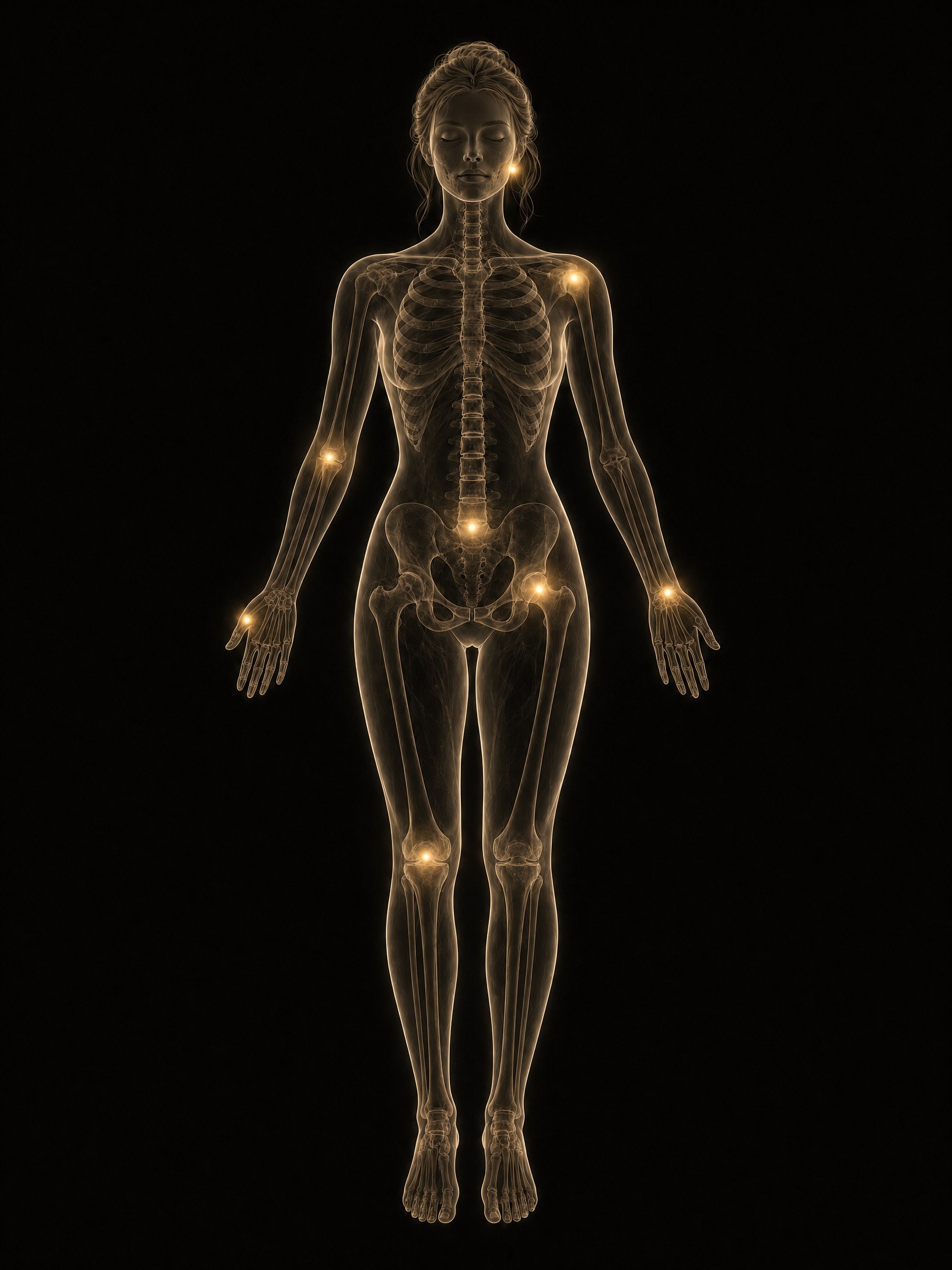
What the ache is really telling you.
- ✦Stiff thumbs and hands in the morning — the ache that loosens with coffee. It's not overuse. It's not "just aging." It's the base of your thumb doing something specific.
- ✦Sore knees going DOWN stairs — not up. That's the tell. Cartilage doesn't wear out on one specific direction of movement. Estrogen loss changes how the joint moves.
- ✦The "tennis elbow" you got without playing tennis — or the "carpal tunnel" that isn't. When a whole cohort of women wake up with tendon pain in their 40s and 50s, it's not because they all suddenly overused something.
- ✦SI joint and tailbone pain — the one-sided ache that only goes away when you move, comes right back when you sit. Started on one side. Now it's both. Nobody connected it to hormones because nobody was looking.
- ✦Plantar fasciitis — the pain in your heel with your first step out of bed. Women didn't just start walking wrong at 47.
- ✦Achilles tendon pain — the tendon that started hurting without an injury. Tendons need collagen. Collagen needs estrogen. Simple as that.
- ✦Neck and trapezius tension — the crick that shows up no matter how you sleep. The "I need a massage" that a massage doesn't fix.
- ✦Rib cage / costochondritis — the sharp chest wall pain that isn't your heart. Women get sent for cardiac workups. It's inflammation in the cartilage between your ribs.
- ✦Trigger finger — the finger that catches when you close your hand. Feels like a stuck gear. Not aging. Inflammation.
The Estrogen Silence — the science of the ache.
Estrogen has a job most women were never told about: it keeps inflammation quiet in every tissue that has estrogen receptors.
Cartilage has them. Synovial fluid has them. Tendons and ligaments have them. Even the fascia around your muscles has them.
When estrogen drops, inflammation gets loud everywhere at once — and it shows up loudest in joints, because joints are where all four of those tissues meet.
It's not that your body is falling apart. It's that the hormone that kept everything quiet has left the building.
When the quiet lifts, you finally hear how much was actually going on underneath.
Your orthopedist didn't ask about your hormones. Your gynecologist didn't ask about your joints. Neither one was trained to connect the dots between the two — and neither one was going to notice that the whole cohort of women 45 to 60 walking into their offices is complaining of the same thing.
The pain in your thumbs and your knees and your hips is real. It has a name that isn't arthritis. And once you know what it actually is, the path forward looks completely different.
This isn't arthritis. This is estrogen loss showing up in tissue.
And unlike the "aging" story you've been told, this one is addressable — from the tissue up.
Begin tonight.
Not every ache has the same solution. But every ache has a starting point — and there are four moves that build a real foundation before you touch a single prescription.
-
✦ ONEPeptides for tissue repair. BPC-157 for tendons and ligaments. TB-500 for soft tissue and fascia. GHK-Cu for collagen synthesis. Small doses. Consistent timing. Not overnight — but real. These are what the body was using before, quietly, when estrogen was doing its job.
-
✦ TWOThe anti-inflammatory stack. Omega-3 (2-3g EPA/DHA daily) — the foundation. Curcumin with BioPerine — for inflammation you can feel. Collagen peptides + vitamin C — the pair, not the powder alone. Vitamin D3 + K2 — bone and joint. Both. Take them consistently, or don't bother.
-
✦ THREEStrength train. Even with sore joints. Counter-intuitive but critical: load-bearing exercise is protective. Cartilage needs compression to stay healthy. Tendons need controlled stress to rebuild. Rest makes it worse. Start light. Go slow. But go. Your joints don't want to be babied. They want to be used.
-
✦ FOURThe HRT conversation. Ask a menopause-trained provider (not just any doctor) about estrogen therapy. Joint pain relief is one of the least-talked-about but most-reported benefits. If joints hurt because estrogen dropped, the most direct answer is: bring some estrogen back. Talk to someone who was actually trained on it.
Start with peptides and supplements while you book the HRT conversation. By the time you sit down with the right provider, you'll already feel the difference — and you'll know what questions to actually ask.
Try every tool free for 7 days.
Drop your email and unlock all 12 tools — unlimited use, no credit card, no commitment. The peptide calculator that does the math. The supplement timing that actually matters. The interaction checker that catches what your pharmacy missed.
No spam · No hard sells · Cancel anytime